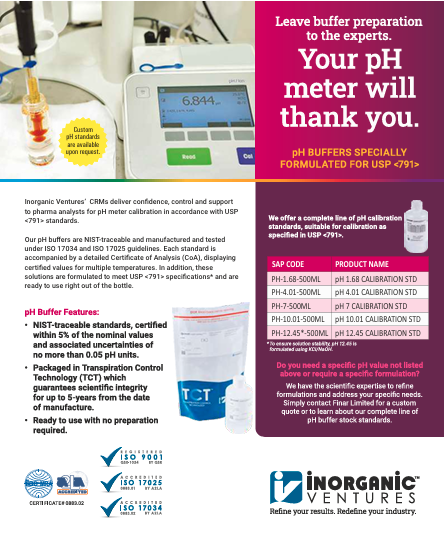
Looking for precise and reliable pH buffer solutions? For precise and reliable pH measurement, your results are only as good as the standards you calibrate against. Our premium-grade laboratory pH buffer solutions are NIST-traceable, manufactured and tested under strict ISO 17034 and ISO 17025 guidelines, and supplied with a detailed Certificate of Analysis showing certified pH values at multiple temperatures. Whether you need a ph buffer for routine meter calibration, pharmaceutical testing, or environmental monitoring, we supply a complete range of calibration standards from pH 4.0 to pH 10.0 with pan-India delivery.
We supply ph buffer solution across the standard calibration range. The table below maps each pH value to its typical application and calibration role:
pH Value | Typical use | Common application | Calibration point |
pH 4.00 | Acidic range calibration | Food & beverage, wastewater, soil testing | Lower calibration point |
pH 7.00 | Neutral calibration | Pharmaceutical QC, water analysis, general lab | Mid-point calibration |
pH 9.20 | Alkaline range calibration | Environmental monitoring, industrial water | Upper calibration point |
pH 10.00 | High alkaline calibration | Cement testing, industrial processes | Extended range calibration |
A ph buffer solution is a chemically prepared liquid that resists changes in pH when small amounts of acid or base are added to it. In analytical chemistry, pH buffers are not used as reaction media they are used as reference standards to calibrate pH meters and electrodes before measurement. By measuring a buffer of known, certified pH value, you establish that your instrument reads correctly across the relevant pH range, ensuring that subsequent measurements of unknown samples are accurate and traceable to national or international measurement standards.
The accuracy of your pH measurement is determined entirely by the quality of the buffer used for calibration. This is why NIST-traceability, ISO certification, and a documented Certificate of Analysis are essential for any laboratory where pH measurements are used for quality control, regulatory compliance, or research documentation.
NIST-Traceable Accuracy: Each buffer is certified with an accuracy of ±0.05 pH units. NIST traceability means the certified pH value is linked to primary measurement standards maintained by the National Institute of Standards and Technology (USA), a global reference for pH measurement. For laboratories working under ISO 17025 accreditation, GLP, GMP, or USP compliance frameworks, NIST-traceable buffers provide the documented traceability needed for reliable pH measurement.
‘USP <791> Compliant Formulated to meet USP <791> specifications for pH determination in pharmaceutical applications. USP <791> is the pharmacopoeial standard governing pH measurement methodology for drug product testing. Buffers complying with this standard are accepted by pharmaceutical manufacturers, contract research organisations, and regulatory bodies for use in validated analytical methods.
Advanced TCT Packaging: maintaining scientific integrity and shelf-life for up to 5 years from the date of manufacture Standard buffer bottles degrade gradually from CO₂ absorption through the cap and sidewalls CO₂ dissolves in the solution, forming carbonic acid that shifts the pH value over time. Transpiration Control Technology (TCT) packaging prevents this by blocking gas permeation through the container walls and closure, maintaining the certified pH value for the full 5-year shelf life from manufacture. Most conventional buffer packaging achieves 12–18 months before opening and 3–6 months after opening. TCT packaging eliminates this degradation concern entirely.
Ready to Use: Our pH buffers are ready to use right out of the bottle no dilution or preparation required. All buffers are supplied as ready-to-use solutions no dilution, mixing, or preparation required. Pour directly into the calibration cup or electrode holder, calibrate your instrument, and discard the used portion. Never return used buffer to the original bottle this contaminates the remaining solution and invalidates the certified pH value.
Trusted Brands Available: Merck, VWR, Eutech, Loba In addition to our own certified range, we supply ph calibration solution from four leading brands. Each serves a different buyer profile:
Brand | Known for | Best suited for |
Merck | ISO 17034 certified reference materials — highest traceability standard | Regulated pharmaceutical QC, GLP/GMP environments, metrology labs |
VWR | Broad range of certified buffers with temperature correction charts | General analytical laboratories, multi-parameter calibration |
Eutech | Colour-coded buffer solutions for fast visual identification in the field | Environmental monitoring, water quality, field instruments |
Loba | Economical laboratory grade buffers with CoA | Teaching labs, routine industrial QC, high-volume applications |
Proper calibration technique ensures your ph buffer solution delivers its certified accuracy. Follow these steps:
Correct storage protects the certified pH value throughout the shelf life:
Lab Chemicals has supplied certified laboratory pH buffer solutions, analytical reagents, and calibration standards to pharmaceutical manufacturers, NABL-accredited testing laboratories, environmental monitoring organisations, and research institutions across India for over three decades. We are authorised distributors for Merck, VWR, Eutech, and Loba supplying genuine certified products with CoA documentation at every pH value you need. Our technical team can advise on buffer selection, brand suitability for your application, and volume pricing for institutional orders.
A pH buffer solution is used to calibrate pH meters and electrodes before measurement. By measuring a solution of known, certified pH value, you confirm that your instrument reads accurately. pH buffers are not used in samples they are reference standards. They are essential in pharmaceutical QC, environmental monitoring, food testing, water analysis, and any laboratory where pH measurements are used for quality control or regulatory compliance.
NIST traceable means the certified pH value of the buffer is linked through an unbroken chain of comparisons to primary measurement standards maintained by the National Institute of Standards and Technology (USA). This traceability chain is documented in the Certificate of Analysis. For laboratories operating under ISO 17025 accreditation, GLP, GMP, or USP compliance frameworks, NIST-traceable pH buffers are required to demonstrate measurement validity.
pH 4.0 buffer is used as the lower calibration point, representing the acidic range used in food testing, wastewater, and soil analysis where samples are acidic. pH 7.0 is the neutral mid-point calibration standard used in almost every two-point calibration procedure. pH 9.2 or 10.0 is the upper alkaline calibration point used for samples expected to be alkaline, such as industrial process water, cement testing, or alkaline cleaning solutions. Two-point calibration uses pH 4.0 and 7.0, or 7.0 and 9.2. Three-point calibration uses all three.
Standard pH buffer bottles in conventional packaging typically maintain certified accuracy for 12–18 months before opening and 3–6 months after opening, as CO₂ absorption through the packaging gradually shifts the pH value. Our TCT-packaged buffers maintain certified accuracy for up to 5 years from manufacture, as the Transpiration Control Technology packaging blocks gas permeation. Always check the expiry date and discard any buffer showing turbidity or discolouration.
Allow electrode and buffers to reach the same temperature (ideally 25°C). Rinse the electrode with deionised water and blot dry. For two-point calibration, measure pH 7.0 first, confirm stable reading, then measure pH 4.0 or 9.2. For three-point calibration, use pH 4.0, 7.0, and 9.2 in sequence. Use fresh buffer for each calibration session never return used buffer to the original bottle. Record the buffer lot number and calibration result in your instrument log.
USP <791> is the United States Pharmacopoeia chapter governing pH determination methodology for pharmaceutical products. It specifies the equipment, calibration procedures, and reference standards required for pH measurement in drug product testing. pH buffer solutions compliant with USP <791> meet the purity, concentration, and accuracy requirements specified in this standard. For pharmaceutical manufacturers and contract laboratories performing validated analytical methods, using USP <791> compliant buffers is a regulatory requirement.
No. Buffer solution that has been used for a calibration session should be discarded. Pouring used buffer back into the original bottle introduces contamination from the electrode, the calibration vessel, and atmospheric exposure this alters the pH value and invalidates the certified standard. Always pour a fresh quantity of buffer for each calibration. The ready-to-use format of our buffers makes this straightforward with no waste from dilution or preparation.