
Product Code
Product Name
CAS No.
Packing Size
Brand
Product Code
Product Name
CAS No.
Packing Size
Brand
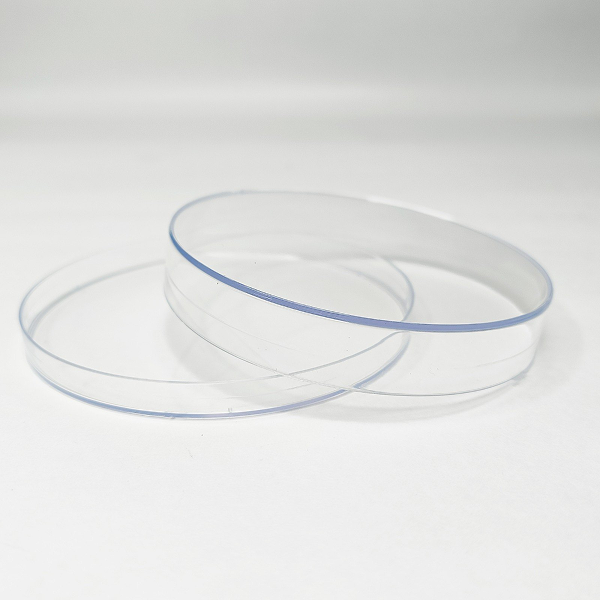
Laboratories rely on petri dish plastic consumables for precise and safe culturing of microorganisms across microbiology, pharmaceutical, food testing, and academic applications. These 90mm disposable petri dishes are made from optically clear, non-toxic polystyrene, providing a smooth surface and unobstructed observation of culture growth throughout incubation. Gamma-radiated to a Sterility Assurance Level of SAL 10⁻⁶ and supplied in sealed sleeves of 10 per sleeve (480 per pack), they are ready for immediate use without any preparation. Their ergonomic design makes them easy to handle and stack, reducing workflow disruption during high-volume work.
| Parameter | Details |
| Product type | Disposable petri dish (single-use) |
| Material | Polystyrene (PS) — optically clear, non-toxic |
| Size | 90 × 15.8 mm (diameter × height) |
| Sterilisation method | Gamma radiation |
| Sterility Assurance Level | SAL 10⁻⁶ (validated per ISO 11137) |
| ISO compliance | ISO 24998 — single-use plastic laboratory ware |
| Temperature tolerance | Retains shape up to 55°C |
| Packaging | Sleeve of 10 Nos, 1 pack = 480 Nos total |
| Lid type | Fitted lid with tight seal for contamination prevention |
| Suitable for | Bacterial and fungal cultures, agar plates, environmental monitoring |
These disposable petri dishes are sterilised by gamma radiation, which penetrates the sealed packaging and eliminates microorganisms without leaving chemical residues. Unlike ethylene oxide (EO) sterilisation, gamma irradiation does not require a post-process aeration period and leaves no toxic residue on the dish surface. The process achieves a Sterility Assurance Level of SAL 10⁻⁶, meaning fewer than one non-sterile unit per million, validated in accordance with ISO 11137. This makes them suitable for use in regulated environments including pharmaceutical QC, sterility testing, and clinical microbiology.
These plastic petri plates are manufactured in compliance with ISO 24998 — the international standard for single-use plastic laboratory ware. ISO 24998 specifies dimensional accuracy, material properties, lid fit, and performance requirements for disposable culture plates. Compliance ensures consistent quality across batches, compatibility with automated plate readers and laboratory handling systems, and acceptance under GMP and ISO 17025 laboratory quality frameworks.
The polystyrene construction provides a crystal-clear base and lid, allowing continuous visual monitoring of culture growth, colony morphology, and agar condition throughout incubation without removing the lid. This is particularly important in quantitative microbiology where colony counting under the dish is required, and in time-sensitive clinical workflows where early-growth detection matters.
Each dish maintains consistent 90mm diameter and 15.8mm height with tight dimensional tolerance, ensuring uniform agar depth when poured, compatibility with standard colony counters and image analysis systems, and predictable stacking behaviour in incubators. Dimensional consistency also supports method validation documentation, as plate geometry affects diffusion-based assays including antibiotic sensitivity testing.
The flat, warp-resistant base and interlocking lid design allow stable stacking up to manufacturer-recommended heights in both upright and inverted positions. Plates retain their shape and dimensional accuracy at incubation temperatures up to 55°C, preventing warping that could compromise agar contact and lead to condensation-related contamination issues.
| Factor | Disposable petri dishes (this product) | Reusable glass petri dishes |
| Sterility | SAL 10⁻⁶ gamma-radiated, guaranteed sterile | Requires autoclaving — sterility dependent on cycle validation |
| Cross-contamination risk | Eliminated — single use only | Present if cleaning or sterilisation is incomplete |
| Workflow speed | Ready to use immediately | Requires washing, drying, and autoclaving between uses |
| Regulatory compliance | Consistent, traceable SAL documentation per batch | Variable — dependent on in-house sterilisation records |
| Volume throughput | High — 480 per pack, cost-effective at scale | Limited by autoclave capacity and turnaround time |
| Best for | Pharmaceutical QC, food testing, clinical micro | Research where specific glass surface properties are required |
The primary application of these disposable petri dishes is bacterial and fungal culture growth whether for colony counting, streak plating for isolation, or qualitative presence/absence testing. Their smooth polystyrene surface supports even agar spread and colony formation without satellite growth artefacts. Used routinely for Mueller-Hinton agar in antibiotic susceptibility testing, blood agar for clinical isolates, and Sabouraud dextrose agar for fungal identification.
In pharmaceutical manufacturing and QC, petri dish plastic consumables are used for environmental monitoring (settle plates, contact plates), bioburden testing of raw materials and finished products, media fill validation runs, and sterility testing of parenteral preparations under ISO 13408 and USP <71> protocols. For pharmaceutical labs requiring complete audit trails of disposable consumables, these dishes are often ordered alongside other validated sterile consumables including autoclavable bags for safe disposal of contaminated culture materials and plastic disposable syringes for inoculum transfer in sterility testing workflows.
Food and beverage quality control labs use these dishes for total plate count (TPC), yeast and mould testing, and pathogen detection on selective media. Environmental testing labs use them for air and surface monitoring using standard settle plate methodology. Academic institutions use them for routine microbiology practicals, providing students with ready-to-use sterile plates that eliminate preparation time and ensure experimental reproducibility.
Lab Chemicals supplies laboratory consumables, analytical reagents, and life science products to pharmaceutical manufacturers, NABL-accredited testing laboratories, food testing facilities, academic institutions, and research organisations across India for over three decades. We supply these gamma-radiated plastic petri dishes in packs of 480 with short lead times and pan-India delivery. Technical documentation including product data sheets is available on request. Our team can advise on compatible sterile consumables for your complete microbiology workflow, from culture media to waste disposal.