
Vacuum Oven
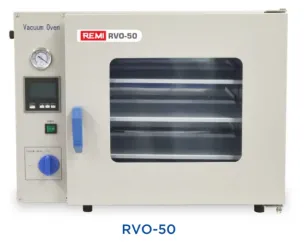
Laboratory Vacuum Oven for Drying Heat-Sensitive Samples
A vacuum oven is one of the most reliable instruments for drying materials that cannot tolerate the temperatures or oxidising conditions of a conventional hot air oven. By reducing chamber pressure well below atmospheric, these ovens remove moisture at lower temperatures and in an inert environment preserving sample integrity, preventing degradation, and delivering consistent, reproducible drying results. Lab Chemicals supplies the RVO-50 laboratory vacuum oven, a microprocessor-controlled unit designed for research, quality control, and industrial drying applications.
What is a vacuum oven?
A vacuum oven is a temperature-controlled chamber that operates at reduced pressure, created by an external vacuum pump. Unlike standard ovens that rely on hot air convection, a vacuum oven removes moisture by lowering the chamber pressure below the vapour pressure of water causing it to evaporate at a much lower temperature than normal. This makes it particularly effective for drying hygroscopic substances, heat-sensitive compounds, and materials where oxidation during drying would damage the sample or alter its properties.
How a laboratory vacuum oven works?
Vacuum drying principle
The materials to be dried are placed on aluminium trays inside the stainless steel chamber. An external vacuum pump connected to the oven door reduces the internal pressure — on the RVO-50 to an ultimate vacuum of 133 Pa. At this low pressure, the boiling point of water drops significantly, allowing moisture to evaporate from the sample at temperatures that would be too low to cause drying under normal atmospheric conditions. Heat is transferred to the samples by conduction through the aluminium shelves and the chamber walls, ensuring uniform drying across the entire load. The oven door is sealed airtight during operation to maintain the vacuum throughout the drying cycle.
Inert gas backfilling
For certain applications particularly where oxidation or reaction with atmospheric oxygen is a concern the chamber can be backfilled with an inert gas such as nitrogen or argon after the vacuum cycle. This is especially useful for rapid drying of reactive compound materials, pharmaceutical intermediates, and moisture-sensitive organic compounds where even trace oxygen exposure after drying would compromise sample quality. The low-pressure environment minimises oxidation during the entire drying process, making vacuum ovens the preferred choice for oxygen-sensitive materials
Key features
Feature | Benefit to your lab |
Microprocessor controller with digital display | Set and maintain precise temperatures with ±1°C stability ensures reproducible drying results across every cycle and every batch. |
Dual-layer tempered glass door | Monitor your samples visually without breaking the vacuum seal or opening the chamber mid-cycle. |
Adjustable aluminium expansion shelves | Configure shelf spacing to accommodate samples of different heights and trays of varying sizes. |
Stainless steel chamber | Chemically resistant interior compatible with solvents, acids, and moisture-laden samples without corrosion risk. |
0.1°C display resolution | Fine temperature increments allow precise protocol matching, important in pharmaceutical and analytical applications. |
Airtight door seal | Maintains vacuum integrity throughout the drying cycle prevents pressure fluctuation that could affect drying uniformity. |
| Technical Specifications | ||
| Model | RVO-50 | |
|---|---|---|
| Temperature Range | RT+10°C to 200°C | |
| Display Resolution | 0.1°C | |
| Temperature Stability | ±1°C | |
| Vacuum Degree | 133 Pa | |
| Chamber Material | Stainless steel | |
| Aluminum Shelves | 2 | |
| Ambient Temperature | +5~40°C | |
| Power Consumption | 1450W | |
| Interior Dimension (W x D x H) (mm) | 415X370X345 | |
| Exterior Dimension (W x D x H) (mm) | 730x560x550 | |
Common laboratory applications
- Pharmaceutical manufacturing and QC — drying active pharmaceutical ingredients (APIs), excipients, and granules without thermal degradation or oxidation
- Food moisture testing — removing residual moisture from food samples for accurate moisture content determination
- Analytical and life-science labs — preparing dried reference standards and reagents, including pH buffer components that require controlled moisture content before preparation
- Electronics and PCB manufacturing — outgassing and drying of electronic components and assemblies before conformal coating or encapsulation
- Polymer and resin processing — degassing resins and drying polymer granules before moulding or compounding
- Environmental testing — drying soil and sediment samples for gravimetric moisture content analysis
- Research and development — drying catalyst materials, nanoparticles, and other moisture-sensitive compounds under controlled conditions
Why order from Lab Chemicals?
Lab Chemicals has been supplying laboratory instruments, analytical reagents, and consumables to pharmaceutical manufacturers, research institutions, food testing labs, and industrial facilities across India for over three decades. We are authorised distributors for leading global brands including Merck, Sigma-Aldrich, and Millipore, and our customer base includes NABL-accredited laboratories, GMP-certified pharmaceutical units, and university research departments. The RVO-50 laboratory vacuum oven is supplied with short lead times, pan-India delivery, and two adjustable aluminium shelves as standard. Our applications team which includes qualified chemists with hands-on experience in analytical and pharmaceutical lab environments can advise on compatible vacuum pump selection, installation requirements, and cycle development for your specific drying protocol. We also supply complementary bench instruments including weighing balances for laboratory use, so you can source all core analytical equipment from a single trusted supplier.
FAQs
A vacuum oven is used to dry materials that are hygroscopic, heat-sensitive, or prone to oxidation during conventional oven drying. Common applications include drying pharmaceutical ingredients, food samples for moisture analysis, electronic components, polymer granules, and research-grade compounds where temperature or oxygen exposure would damage the sample. The reduced-pressure environment allows moisture to be removed at lower temperatures than a standard hot air oven.
A laboratory vacuum oven works by reducing the pressure inside a sealed chamber using an external vacuum pump. At lower pressure, the boiling point of water drops so moisture evaporates from the sample at temperatures well below 100°C. Heat is transferred to the samples by conduction through the aluminium shelves. The result is gentle, uniform drying that preserves the chemical and physical integrity of sensitive materials.
A hot air oven dries samples using circulating hot air at atmospheric pressure — suitable for general sterilisation and glassware drying but not for heat-sensitive or oxidation-prone materials. A vacuum oven removes moisture at much lower temperatures in a near-oxygen-free environment, making it the correct choice for pharmaceutical compounds, food samples, and reactive materials. The key trade-off: a vacuum oven requires an external pump and is slower; a hot air oven is simpler and faster for non-sensitive materials.
The RVO-50 achieves an ultimate chamber vacuum of 133 Pa. A two-stage rotary vane vacuum pump with a pumping speed of at least 2 L/s is generally recommended for this chamber volume (50 litres). Contact our technical team before ordering if you need a compatible pump recommendation for your specific drying application.
The RVO-50 operates from RT+10°C up to 200°C with ±1°C temperature stability and 0.1°C display resolution. This range covers the vast majority of routine drying protocols in pharmaceutical, food testing, and analytical chemistry applications. For applications requiring temperatures above 200°C, contact us to discuss alternatives.
Yes. Vacuum ovens are widely used in pharmaceutical manufacturing and QC for drying active pharmaceutical ingredients (APIs), granules, and excipients. The combination of low drying temperature and minimal oxygen exposure makes them suitable for thermally labile and oxidation-sensitive compounds. Confirm with your SOPs whether the RVO-50 specification meets your specific GMP documentation requirements before ordering.
No — inert gas backfilling is an optional capability, not a requirement for standard operation. The oven can be used in vacuum-only mode for routine drying. Inert gas (typically nitrogen or argon) is introduced when the application requires an oxygen-free atmosphere after the vacuum cycle for example, when drying reactive intermediates or moisture-sensitive compounds that must not contact air after drying.