
Magnetic Stirrers Manufacturers and Suppliers
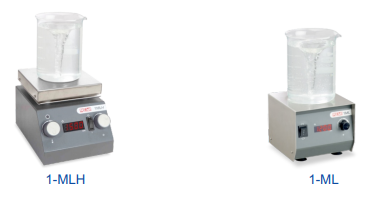
Magnetic Stirrers & Hot Plate Stirrers for Laboratories
Reliable mixing and precise speed control are at the core of everyday lab work from preparing buffers and dissolving reagents to running synthesis reactions and testing formulations. Lab Chemicals supplies standalone magnetic stirrers and combined hot plate units, designed for a wide range of laboratory stirring applications handling volumes up to 10 litres. Whether you need a standalone stirrer or a combined hot plate and magnetic stirrer, both series offer consistent performance in demanding lab environments.
Magnetic Stirrers for Mixing
The magnetic stirrer range compact, stainless steel-housed magnetic stirrers built for applications where mixing is required without heating. Powered by a Permanent Magnet DC (PMDC) motor, these units deliver high torque even at low speeds and maintain stable rotation regardless of changes in sample viscosity or volume a common problem with cheaper AC motor alternatives.
Accurate stepless speed control with a digital display allows smooth adjustment from low-speed gentle mixing up to 1200 RPM. All models are fully enclosed, making them suitable for use in corrosive laboratory atmospheres where chemical vapours are present. Available in three capacities 1 litre, 2 litre, and 5 litre with a compact 500 ml entry model (MS 500) for smaller bench setups.
Key Features
PMDC motor | Higher torque at low speeds. Maintains speed stability even with small-volume or viscous samples no stalling or speed drop as the sample thickens. |
Digital speed indicator | Accurate RPM readout on digital display. Stepless control for smooth, precise speed variation up to 1200 RPM. |
Totally enclosed unit | Sealed housing designed for use in corrosive or chemically active lab environments safe around acid vapours and solvent fumes. |
PTFE-coated stir bars | Chemically inert stir bars included with each unit. Compatible with acids, bases, and organic solvents. |
Better speed regulation | Excellent speed stability maintained even at small volume and low speed settings important for reproducible protocols. |
Stepless speed control | Smooth variation with no fixed speed steps set the exact RPM your protocol requires. |
| Technical Specifications | |||||
| Models | Stirring Capacity (Ltrs) | Heating Capacity (Watts) | External Dimensions (W x D x H) mm | Stirring Paddle (PTFE Coated) | |
|---|---|---|---|---|---|
| Ltrs | Watts | (W x D x H) mm | Model | Ø x length | |
| Stirrers without Hotplate | |||||
| MS 500 | 500 ml | - | 105 x 135 x 70 | Q-18A | 7 x 15 mm |
| Stirrers without Hotplate (with Digital Speed Indicator) | |||||
| 1 ML | 1 | - | 150 x 220 x 150 | Q-19 | 9 x 25 mm |
| 2 ML | 2 | - | 150 x 220 x 150 | Q-19A | 9 x 35 mm |
| 5 ML | 5 | - | 180 x 220 x 150 | Q-20A | 13 x 50 mm |
| Stirrers with Hotplate (with Digital Speed Indicator) | |||||
| 1 MLH | 1 | 150 | 200 x 225 x 185 | Q-19 | 9 x 25 mm |
| 2 MLH | 2 | 300 | 200 x 225 x 185 | Q-19A | 9 x 35 mm |
| 5 MLH | 5 | 500 | 200 x 225 x 185 | Q-20A | 13 x 50 mm |
Magnetic Stirrer Hot Plate Models
The hot plate magnetic stirrer range builds on the standalone platform by adding a stainless steel hot plate, making these units a complete magnetic stirrer hot plate solution for labs that need simultaneous heating and mixing. Heat energy is regulated by a built-in energy regulator, letting you control plate temperature independently from stirring speed useful for workflows like dissolving solids at elevated temperature, preparing culture media, running reflux setups, or heating reagents while maintaining consistent agitation.
How the hot plate and magnetic stirrer combination works?
In a combined unit, the hot plate heats the vessel from below while the drive magnet beneath the plate rotates the PTFE-coated stir bar inside the vessel. Because the two functions are controlled independently, you can heat without stirring, stir without heating, or run both together giving you full control over your reaction conditions from a single instrument. This makes the combined hot plate stirrer the practical choice for general-purpose lab benches where space and simplicity matter. It is also referred to as a magnetic mixer hot plate in some lab equipment catalogues, describing the same combined-function instrument.
What to consider when choosing a stirrer?
Stirring capacity and vessel size
Match the model to your working volume. The MS 500 suits micro-scale work in 100–500 ml beakers. The 1-litre models cover most routine lab tasks. For larger preparations 2 to 5 litre vessels used in buffer batches, media preparation, or synthesis step up to the 2-litre or 5-litre models accordingly. The stir bar size is matched per model and ships with the unit.
Speed range and motor type
The PMDC motor across the full range maintains precise speed even when sample viscosity increases or volume changes mid-run a limitation of basic AC units. If your work involves gel-forming materials, protein solutions, or samples that change consistency during preparation, the torque stability of a PMDC motor is a practical advantage.
Heating requirement
Choose the standalone magnetic stirrer models if your samples are temperature-sensitive enzyme preparations, cell culture reagents, or heat-labile compounds and mixing alone is sufficient. Choose the hot plate stirrer models when your protocol requires heating alongside agitation, such as dissolving inorganic salts, preparing agar, or maintaining a specific reaction temperature during mixing.
Working environment
All models are fully enclosed and designed for corrosive atmospheres, making them suitable for chemistry labs working with acid vapours, solvent fumes, or other reactive environments where unsealed electrical equipment poses a risk.
Common lab applications
- Buffer and reagent preparation including
- pH buffer solutions in analytical, biochemistry, and life-science labs
- Dissolution testing and QC sample preparation in pharmaceutical labs
- Organic synthesis, recrystallisation, and reflux in chemistry labs
- Culture media and agar preparation in microbiology labs
- Sample digestion and extraction in food testing and environmental labs
- Titrations and volumetric analysis in industrial and teaching labs
- Homogenisation and formulation research in cosmetic and chemical manufacturing
Why order from Lab Chemicals?
We supply the full range of standalone stirrers and hot plate stirrer units with short lead times and pan-India delivery to research institutions, pharmaceutical companies, diagnostic labs, manufacturing facilities, and universities. All units come with the appropriate PTFE stir bar for their capacity range. Our technical team can help you select the right model based on vessel size, heating requirement, and working environment — contact us before ordering if you have application-specific questions. We also supply complementary instruments including weighing balances for laboratory use, ensuring you can source all core bench equipment from a single trusted supplier.
FAQs
The magnetic stirrers they mix but do not heat. The combined hot plate stirrer units that add a stainless steel heating surface, allowing simultaneous heating and stirring from a single instrument. If your protocol requires temperature control alongside mixing, the combined hot plate stirrer is the appropriate choice.
PMDC stands for Permanent Magnet DC motor. Unlike standard AC variable-speed motors, a PMDC motor maintains consistent torque and speed stability even at low RPM settings and when sample viscosity changes. The stir bar keeps spinning at the set speed rather than slowing down or stalling when the sample thickens important for reproducible results in protein work, gel preparation, and viscous reagent mixing.
Yes. On the combined hot plate stirrer range also known as a magnetic mixer hot plate the heating function and stirring speed are controlled independently. You can set the stirring speed to zero and use the hot plate function alone, or run both together as needed by your protocol.
The full range handles volumes up to 5 litres (the 5-litre standalone and 5-litre hot plate models). For smaller setups, the MS 500 model covers volumes up to 500 ml. The stir bar size is matched to the capacity of each model.
Yes. All models feature totally enclosed housings designed for corrosive laboratory atmospheres labs working with acid vapours, solvent fumes, or reactive chemical environments. The stir bars are PTFE-coated, resisting most acids, bases, and organic solvents.
All models provide stepless digital speed control up to 1200 RPM. For most routine mixing tasks buffer preparation, reagent dissolving, titrations the operating range of 100–800 RPM covers everyday needs. The digital speed indicator shows actual running speed for consistent protocol conditions.
Each model ships with a matched PTFE-coated stir bar: MS 500 uses Q-18A (7×15 mm), 1 ML/1 MLH use Q-19 (9×25 mm), 2 ML/2 MLH use Q-19A (9×35 mm), and 5 ML/5 MLH use Q-20A (13×50 mm). The bar length should be roughly one-third to half the internal diameter of your vessel.