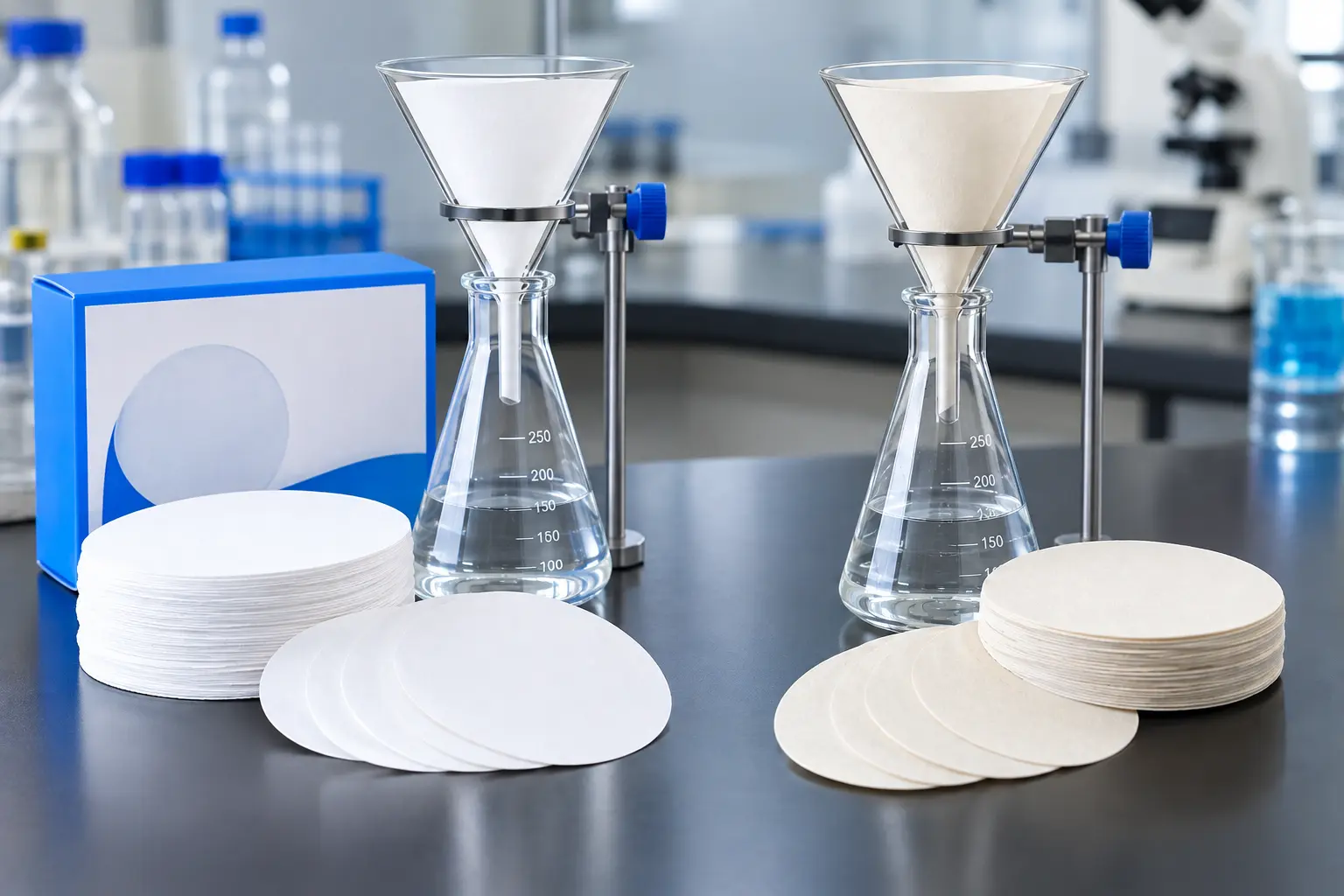
Laboratories use filter paper to separate solid particles from liquids during sample preparation, testing, and analysis. Although different filter papers may look similar, their performance can vary based on factors such as pore structure, retention capacity, flow rate, thickness, and manufacturing consistency.
Whatman filter paper is produced in defined grades for specific laboratory applications. Normal filter paper, by contrast, is a broad term for general-purpose filtration papers that may vary by manufacturer and intended use.
Understanding this difference helps laboratories select a filter paper that matches the sample and testing method. Lab Chemicals provides laboratory filtration products for applications that require consistent, suitable filtration.
What is Whatman filter paper?
Whatman filter paper refers to a range of laboratory filter papers manufactured with defined characteristics for different filtration requirements. Each grade has specific filtration properties, so selecting the right one matters when results depend on consistent sample preparation.
For example, Whatman filter paper 41 is a defined grade used in laboratory filtration. Rather than selecting paper by appearance or general filtering ability, users can choose a grade based on their application requirements.
This is particularly useful for analytical purposes. Particle retention, filtration rate, and ash content all affect how quickly a sample passes through the paper. A given lab grade makes selecting paper easier.
What is normal filter paper?
Normal filter paper generally refers to filter paper intended for basic or general filtration. It suits applications where the main requirement is to separate visible solid particles from a liquid.
However, the term does not identify one particular specification. Different manufacturers may produce general-purpose filter papers with different pore structures, thicknesses, strengths, and filtration rates.
This does not mean that you are comparing like for like when purchasing two products which claim to be normal filter paper. This level of variation may be relevant for typical uses. But for analytical or repeated testing, you may need a more defined filtration medium.
What is the difference between Whatman and normal filter paper?
The main difference is not simply the paper’s appearance or material. It is the degree to which the filtration characteristics are defined and controlled for a particular application.
| Factor | Whatman Filter Paper | Normal Filter Paper |
| Product specification | Available in defined grades | Specifications depend on the manufacturer |
| Filtration characteristics | Grade-specific | Can vary between products |
| Particle retention | Selected according to grade | Depends on the product |
| Filtration rate | Defined for the particular grade | May vary |
| Analytical use | Suitable for specified laboratory applications | More commonly used for general filtration |
| Reproducibility | Designed for consistent performance | Depends on product quality and specifications |
| Selection method | Based on application and grade | Often based on general filtration needs |
For this reason, a laboratory should not select filter paper only by diameter or price. The required retention and flow characteristics are also important.
When the application requires a particular grade, select a defined product such as Whatman No. 41 filter paper rather than unspecified general-purpose paper.
How does filter paper selection affect soil testing?
Filtration can be an important step in soil analysis when a soil sample is mixed with a liquid to prepare an extract or suspension for further testing. The filter paper helps separate unwanted solid particles from the liquid portion used for analysis.
When selecting filtration material for a soil testing kit, the paper should match the testing procedure. Using a filter simply because it fits the equipment may not provide the required filtration characteristics.
Several factors can influence the choice:
- Particle retention: The filter should retain particles that could interfere with the next testing stage.
- Filtration speed: The paper should allow the sample to pass through at a practical rate.
- Sample characteristics: Soil extracts can contain fine particles that behave differently from larger suspended material.
- Testing method: The filter should suit the procedure specified by the kit or laboratory method.
- Consistency: Repeated soil tests may require similar filtration conditions to keep results comparable.
For this reason, consider the filter paper used with a soil testing kit part of the testing process, not just an accessory.
What should you consider before choosing filter paper?
The right filter paper depends on the sample and the purpose of filtration. Before making a selection, laboratories can consider the following points:
- Sample type
Determine whether the sample contains coarse particles, fine suspended solids, precipitates, or other materials that must be retained.
- Required retention
The required particle retention level should match the testing method. A paper that allows unwanted particles to pass through may affect later stages of analysis.
- Filtration speed
Consider how quickly the liquid needs to pass through the filter. Very slow filtration can affect workflow, while excessively fast filtration may not provide the required retention.
- Ash content
For some analytical procedures, the amount of ash left after ignition matters. The filter grade should match the method requirements.
- Filter size
Diameter should be compatible with the funnel, holder, or filtration equipment being used. Size alone, however, should not determine the selection.
- Repeatability
If you perform the same procedure regularly, using a defined filter grade can help maintain consistent filtration conditions between samples.
- Testing requirements
For applications involving analytical work or a soil testing kit, select the filter according to the testing procedure rather than as a general-purpose substitute.
Understanding the right filter for the job
The key difference between Whatman and normal filter paper lies in the level of specification and consistency available for the product. Normal filter paper can work well for routine filtration, but its characteristics may vary between products. Whatman filter papers come in defined grades for specific laboratory requirements.
For laboratories that need to control filtration conditions, selecting the correct grade is important. Consider Whatman No. 41 filter paper when the application requires its specific grade characteristics rather than a general filter paper.
Lab Chemicals offers Whatman filter paper 41 for laboratory applications where a defined filter paper grade is required. Explore the product details and choose the filtration solution that matches the testing method.