Chemical names can vary across laboratories, suppliers, research papers, safety documents, and product catalogues. A substance may have a common name, systematic name, abbreviation, or commercial name. This can make accurate identification difficult, especially when several substances have similar names.
A CAS number provides a consistent reference for identifying a chemical substance. It is widely used in laboratory records, technical documents, procurement, research, and industrial applications. For businesses sourcing chemicals, understanding the CAS number meaning can also help reduce confusion during product selection.
For laboratories and industrial buyers, Lab Chemicals provides a useful reference point when identifying and sourcing laboratory chemicals and related supplies.
What is a CAS number and why is it used?
The CAS number meaning is linked to the unique numerical identifier assigned to a chemical substance by Chemical Abstracts Service. These identifiers are commonly called Chemical Abstracts Service numbers or CAS Registry Numbers.
A CAS number normally appears in a format such as 7778-77-0 or 67-63-0. The numbers are separated by hyphens, with the final digit serving as a check digit.
The number itself does not describe the chemical’s purity, concentration, grade, or performance. It works primarily as an identification reference.
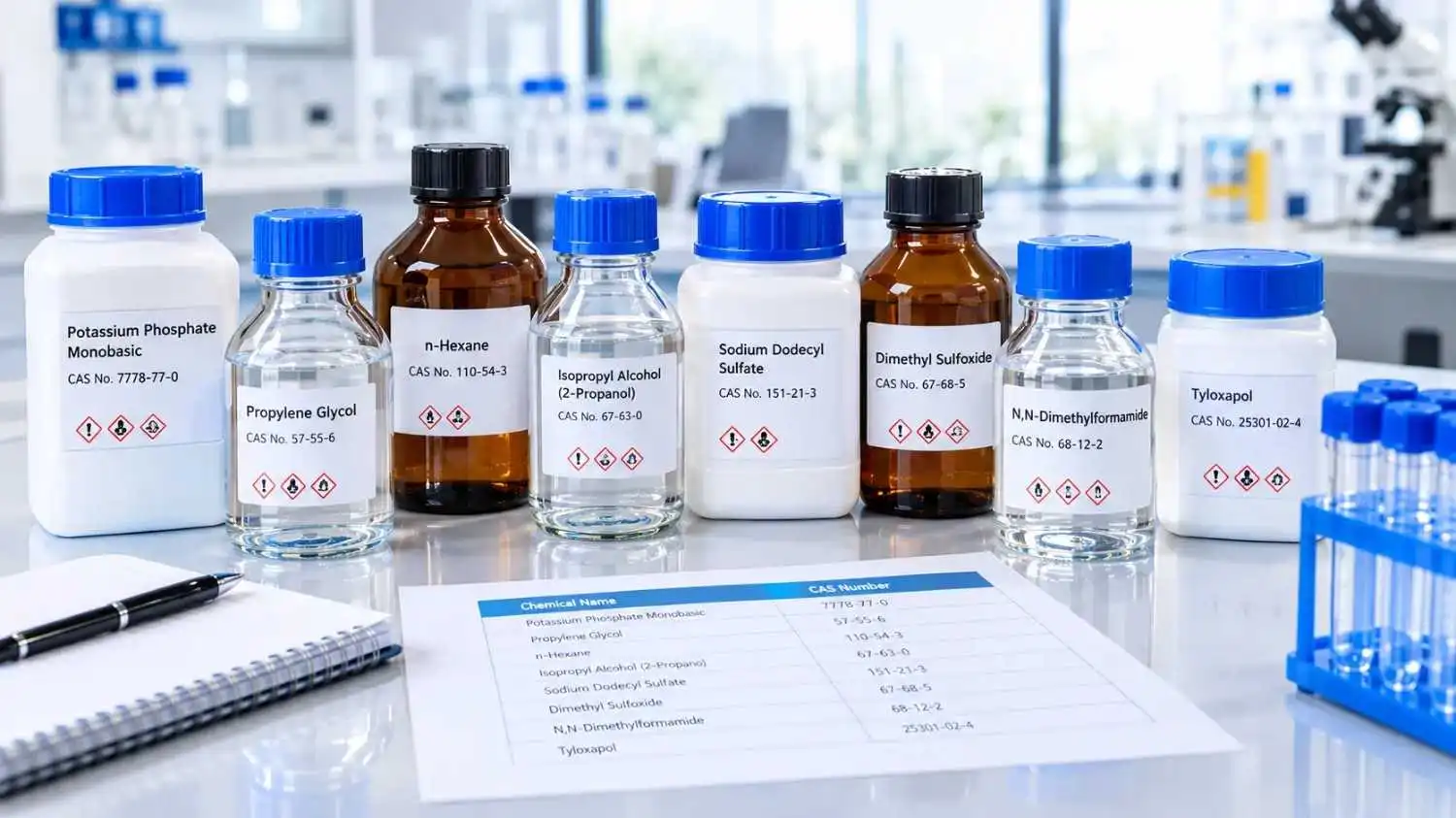
For example, potassium phosphate monobasic has the CAS No. 7778-77-0. The same reference may appear in technical records as CAS 7778-77-0. Likewise, propylene glycol is associated with CAS No. 57-55-6.
This makes a chemical CAS number useful when buyers, manufacturers, researchers, or laboratories use different naming conventions.
How does chemical identification by CAS number work?
Chemical identification by CAS number uses the assigned number as a consistent reference for a particular substance. Instead of relying only on the name printed on a product document, a buyer or laboratory professional can compare the CAS number with other technical information.
Some common examples include:
| Chemical | CAS Number |
| Potassium phosphate monobasic | 7778-77-0 |
| Propylene glycol | 57-55-6 |
| n-Hexane | 110-54-3 |
| Isopropyl alcohol / 2-propanol | 67-63-0 |
| Sodium dodecyl sulphate | 151-21-3 |
| Dimethyl sulfoxide | 67-68-5 |
| N, N-Dimethylformamide | 68-12-2 |
| Tyloxapol | 25301-02-4 |
For example, the CAS No. 7778-77-0 can be used when checking records for potassium phosphate monobasic. The CAS No. 57-55-6 can similarly help identify propylene glycol.
Still, check the number against the chemical name and product documentation. A chemical CAS number is an identification reference, not a replacement for the complete product specification.
Why should laboratories verify a chemical CAS number before procurement?
CAS number verification can be an important part of chemical procurement. It helps buyers confirm that the substance being discussed is the same substance listed in technical documents and supplier records.
This is particularly useful when chemicals have multiple names or when abbreviations are commonly used.
For example, a buyer looking for a propylene glycol supplier may find the material listed simply as propylene glycol, while another document may provide the CAS No. 57-55-6. Comparing both details provides an additional identification check.
The same approach applies when sourcing n-hexane. Its CAS number is 110-54-3, so buyers can check the 110-54-3 reference against supplier documentation.
Before procurement, buyers can verify:
- Chemical name
- CAS number
- Required grade
- Purity or concentration
- Product specifications
- Safety Data Sheet
- Packaging details
- Storage requirements
This process helps reduce errors caused by similar chemical names or incomplete product descriptions.
How do CAS numbers help when chemicals have multiple names?
Chemical names can differ between scientific literature, laboratory records, product catalogues, and supplier documents. A CAS number gives these records a common identification reference.
Consider isopropyl alcohol. It is also known as 2-propanol. A buyer may therefore search for isopropyl alcohol or 2-propanol, while another document may use the chemical name 2-propanol. Both can be checked against CAS 67-63-0.
A similar example is dimethyl sulfoxide, which has the CAS number 67-68-5. Searching or checking CAS No. 67-68-5 can help match the chemical across different technical records.
The same principle applies to N, N-dimethylformamide; its CAS number is 68-12-2, making 68-12-2 another useful reference during identification.
What information can a CAS number confirm?
A chemical CAS number can help establish a substance’s identity, but it does not provide every detail needed to purchase or use that chemical.
A CAS number can help with:
- Identifying a chemical substance
- Matching names across technical records
- Checking supplier catalogues
- Cross-referencing scientific information
- Organising chemical inventories
- Reviewing laboratory documentation
For example, you can check sodium dodecyl sulphate chemical records against CAS 151-21-3. You can then compare the 151-21-3 reference with the supplier’s product information.
A CAS number does not by itself confirm:
- Product purity
- Chemical grade
- Concentration
- Packaging
- Manufacturing quality
- Storage condition
- Supplier quality
- Suitability for a specific application
This distinction is important. A matching CAS number confirms an identification reference, but buyers still need to review the complete product specifications.
What should buyers check alongside a CAS number?
CAS identification should be part of a wider procurement check. Buyers should compare the identifier with the product name and technical details provided.
For example, tyloxapol is associated with CAS 25301-02-4. The 25301-02-4 reference can help confirm that the intended substance matches the supplier’s documentation.
You can do a similar check for potassium phosphate monobasic using CAS No. 7778-77-0. For propylene glycol, the CAS No. 57-55-6 should match the chemical name and other product details.
A practical verification process is:
- Identify the required chemical.
- Check its chemical name.
- Match the chemical CAS number.
- Confirm purity or grade.
- Review the technical specification.
- Check the Safety Data Sheet.
- Confirm packaging and storage requirements.
- Verify the supplier documentation before ordering.
This approach is more reliable than using a chemical name alone.
Why are CAS numbers important for reliable chemical procurement?
CAS identifiers make communication easier between laboratories, researchers, manufacturers, and suppliers. They provide a common reference when different names or abbreviations are being used.
For instance, a buyer may identify a requirement as n-hexane, while procurement records may include the 110-54-3 reference. A laboratory may request isopropyl alcohol 2-propanol, while its documentation uses 67-63-0. In both cases, the identifier supports an additional verification step.
The same applies to sodium dodecyl sulphate, CAS No. 151-21-3, and dimethyl sulfoxide, CAS No. 67-68-5.
Other examples include N, N-dimethylformamide (CAS No. 68-12-2) and Tyloxapol (CAS No. 25301-02-4). Checking these references can help maintain consistency across purchase orders, inventory records, specifications, and safety documentation.
For businesses working with multiple chemical products, consistent identification can also make internal records easier to manage.
How can CAS number verification become a routine check?
CAS number verification can be included as a simple step before chemical procurement or documentation.
The process can be remembered as:
Identify → Match → Verify → Check specifications → Review documentation → Procure
The first step is identifying the required substance. Next, match the name with its chemical CAS number. Buyers can then verify the CAS reference against supplier documentation and review the remaining specifications.
For example, CAS No. 7778-77-0 corresponds to potassium phosphate monobasic, while CAS No. 57-55-6 corresponds to propylene glycol. Similarly, CAS No. 67-68-5 should match dimethyl sulfoxide.
Using CAS identifiers does not remove the need for technical review. Instead, it adds a reliable identification reference to the procurement process.
Using CAS numbers for clearer chemical identification
CAS numbers provide a consistent way to identify chemical substances when names, abbreviations, and descriptions vary. Understanding the CAS number meaning can help laboratory and industrial buyers communicate more clearly and reduce avoidable identification errors.
Whether checking 67-63-0 for isopropyl alcohol, 151-21-3 for sodium dodecyl sulphate, 68-12-2 for N, N-dimethylformamide, or 25301-02-4 for tyloxapol, always check the CAS reference alongside the chemical name and product specifications.
Lab Chemicals helps businesses and laboratories identify and source laboratory chemicals and scientific supplies. Buyers can explore the relevant products and contact Lab Chemicals directly for their chemical procurement requirements.