Reproducibility is the quiet standard behind every credible laboratory result. Analysts spend considerable effort controlling balances, pipettes and reagents, yet mixing and heating are often treated as routine steps that need little attention. In practice, they shape how evenly a solid dissolves, how uniformly a reaction proceeds and how comparable one batch is with the next.
Magnetic stirrers sit at the centre of this work. A well-specified unit delivers stable speed, even agitation and, where required, controlled heat, which removes one more variable from the workflow. This article looks at the engineering behind that stability, the place of combined heating and stirring instruments in laboratory practice, and the way capacity and configuration can be matched to an application.
Why Mixing Consistency Influences Results
Agitation affects how quickly solids dissolve, how readily reagents combine and how evenly temperature spreads through a sample. In buffer preparation, inconsistent mixing can leave concentration gradients. In dissolution testing and quality control sample preparation, uneven agitation introduces variation that is hard to separate from genuine differences between samples. Stable, repeatable stirring keeps these influences constant from one run to the next.
The Engineering Behind Stable Stirring
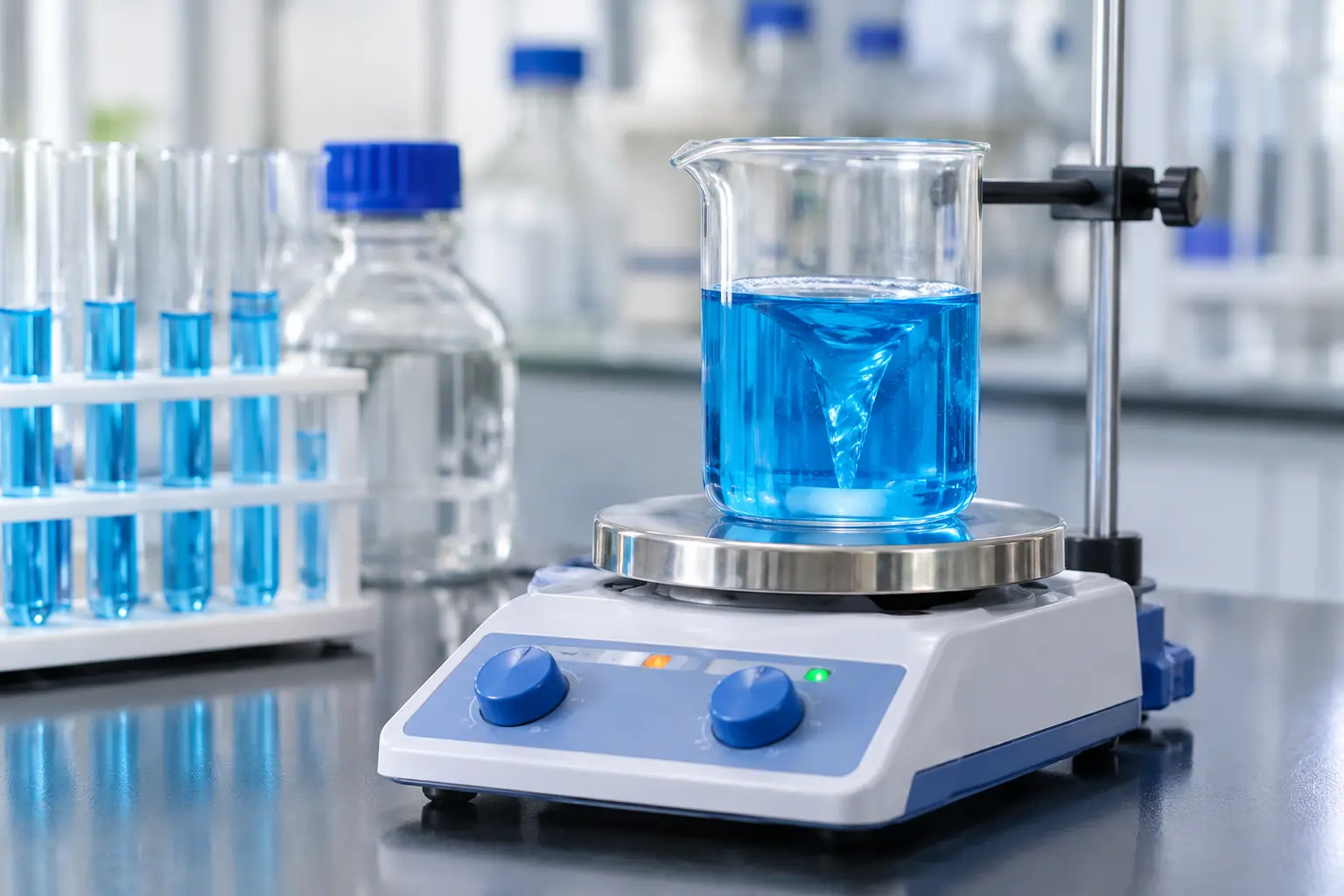
A magnetic stirrer has no shaft entering the liquid. A magnet rotating beneath the plate drives a PTFE-coated stir bar inside the vessel, so the sample stays sealed off from the mechanism and free from lubricants or seals. Several design features determine how steady that rotation is:
- PMDC motor: A Permanent Magnet DC (PMDC) motor provides high torque at low speeds, helping maintain stable stirring when sample volume or viscosity varies within the instrument’s operating range. This matters for gels, protein solutions and preparations that thicken as they dissolve.
- Stepless speed control with digital display: Speed can be set precisely up to 1200 RPM and read directly from the display, so the speed stated in a protocol can be reproduced exactly.
- Fully enclosed housing: Sealed stainless steel construction suits laboratories where acid vapours or solvent fumes are present.
- PTFE-coated stir bars: Chemically inert and compatible with acids, bases and organic solvents.
Integrating Heat: The Magnetic Stirrer Hot Plate
Many protocols call for heat and agitation together. Examples include dissolving inorganic salts, preparing culture media or agar, running reflux setups and warming reagents under steady mixing. A magnetic stirrer hot plate brings both functions into one instrument. A stainless steel plate heats the vessel from below while the drive magnet turns the stir bar above it.
The two functions are controlled independently, allowing heating output and stirring speed to be adjusted separately. Operators can heat without stirring, stir without heating, or run both together. Using a hot plate and magnetic stirrer together helps distribute heat throughout the liquid, reducing temperature gradients that may develop near the vessel base.
Some catalogues list the same combined instrument as a magnetic mixer hot plate. The terminology differs, but the function does not.
The plate setting reflects the temperature of the surface, not of the solution. Laboratories that work to defined temperatures therefore tend to verify the liquid with an independent thermometer or probe and record the reading with the method.
Matching Capacity and Configuration to the Application
The range covers working volumes from small beakers to large preparation vessels, with or without a heating plate.
| Application | Suitable configuration | Working capacity |
| Micro-scale preparation in small beakers | MS 500 standalone | Up to 500 ml |
| Routine buffers, reagents and titrations | 1 ML standalone or 1 MLH with hot plate | Up to 1 litre |
| Media and mid-size batch preparation | 2 ML standalone or 2 MLH with hot plate | Up to 2 litres |
| Larger preparations and synthesis steps | 5 ML standalone or 5 MLH with hot plate | Up to 5 litres |
| Heat-sensitive reagents and enzyme preparations | Standalone ML series | Matched to vessel |
Where heating is required, the MLH models provide 150, 300 and 500 watts across the 1, 2 and 5 litre sizes. Each unit ships with a PTFE-coated stir bar sized for its capacity.
Applications Across Laboratory Sectors
- Pharmaceutical laboratories: dissolution testing and QC sample preparation.
- Chemistry laboratories: organic synthesis, recrystallisation and reflux.
- Microbiology laboratories: culture media and agar preparation.
- Food and environmental testing: sample digestion and extraction.
- Analytical and teaching laboratories: titrations, volumetric analysis and buffer preparation.
- Cosmetic and chemical manufacturing: formulation development, ingredient mixing and preparation of liquid formulations
Supporting Consistent Practice at the Bench
Equipment performance is one part of reproducibility. Laboratories that standardise a few practices tend to see results that compare better between analysts and between batches.
- Record stirring speed, duration and temperature in the method record.
- Use the same vessel type and stir bar size for a given method.
- Raise speed gradually for viscous preparations so the bar stays coupled to the magnet.
- Keep vessels centred on the plate and leave headroom to limit splashing.
- Inspect PTFE stir bars periodically and replace any with a damaged coating.
- Allow the plate to cool before cleaning.
“Consistent mixing and controlled heating may look like small details, yet they carry real weight in analytical and research work. Selecting instruments with stable motors, precise speed control and enclosed construction, then matching their capacity to the application, helps establish reproducibility in everyday laboratory routines. Well-chosen magnetic stirrers work best alongside suitable laboratory vessels. Sourcing through dependable lab glassware distributors in India also helps maintain consistency across laboratory setups. When speed, temperature and vessel selection are properly controlled, every preparation starts from a reliable baseline.”